SEAWORKS (Vanuatu), Main Street, Nambatu, P.O. Box 3242 Port Vila – Phone +678 7100 230 (WhatsApp)
SEAWORKS (New Caledonia), BP 7036 – 98801 Noumea Cedex – Phone +687 87 55 05
We operate throughout Oceania Islands, with the capacity to stay working at remote locations
Underwater INSPECTION Diving: Why
In compliance with all major classification societies, ABC Diving performs following inspections:
- On request of Shipowners, Surveyors, Insurers, Classification Society Inspectors
- Pre-purchase, pre/post Charter, pre and post dry docking
- Damage assessment
- To locate and remove obstruction hazardous to vessels
- Hull coating
MOORINGS:
- Owner peace of mind
- Insurance requirement in case of claim
Maritime INFRASTRUCTURES:
- New Construction or upgrading projects (wharves, jetties, seawalls, pipelines, etc..)
- Damage survey report
WATERWAYS & HARBOR:
- Clearance survey report (wrecks removal, dredging, etc….)
In general terms, PROGRAMMES are arranged so as to perform:
General Initial Survey
Corrosion Inspection
Underwater Cleaning
Critical Inspection
Visual Inspection
The bulk of inspection data is derived from visual inspection techniques.
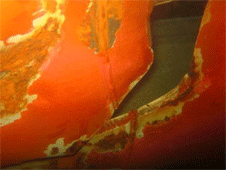
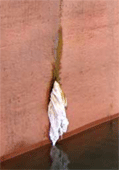
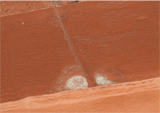
Visual inspection is used to inspect structures for obvious damage such as missing parts, dents, buckles and tears; and to observe and record underwater conditions and features.
Underwater visual inspection is carried out by the human eye, still photography and closed circuit television (CCTV) or video.
These methods are used in conjunction with verbal and written reports from the underwater inspector, who may be a diver or a ROV pilot. Both manned and Remotely Operated Vehicles are normally fitted with still and video cameras.
The various INSPECTION ACTIVITIES have a
basic LOGICAL ORDER
Some tasks have to be done prior to cleaning, while others must be done afterwards. For example, most NDT cannot be performed before cleaning, while obviously a marine growth survey cannot be performed afterwards.
Once this is understood, the various inspection requirements of a client can be arranged so as to create the most efficient inspection programme.
The inspection is a complex subject, some aspects of which involve theories and formulae beyond the scope of this page. More detailed information may be obtained from other sources or Contact us.
You may be interested to know about: our video and still-photography equipment